February 15, 2021

John Singer Sargent

John Singer Sargent (1856 – 1925) was primarily known as a portrait artist and painted many prominent people of his day. These brought him a good living and continued commissions as people saw his work and desired to have their portraits done. He was born to American parents in Italy and travelled most of Europe before ever coming to America in 1876. 

He studied in Paris with Carolus-Duran and painted his teacher’s portrait in 1879 (now at the Clark Art Institute in Williamstown, MA.)

He met Isabella Stewart Gardner in London in 1886 and painted her portrait in 1888. Although it wasn’t on display in her lifetime, it is now hanging in the Gothic Room, which was the site of Sargent’s studio when he became the first artist-in-residence in 1903 at the Gardner museum.

In 1882 Sargent painted El Jaleo, inspired by his trip to Spain in 1879. It is the centerpiece of the Spanish Cloister also at the Gardner museum. Mrs. Gardner and Sargent were close friends for nearly 40 years and she collected many of his paintings.

In 1890 he accepted a commission from the Boston Public Library to do a series of murals called the Triumph of Religion. He painted the panels in London and travelled to Boston to oversee the installation several times from 1895 to 1919. Although one of Sargent’s biographers called the project a disaster, I humbly disagree. At the time I saw it (2007) much had been done in the way of restoration and the paintings are overwhelming as you gaze around the gallery.


To see an overview of the gallery, click here. You can also see larger views of the work on other pages of the Boston Public Library’s Central location. In the week we were there I must have gone there at least three times. If you’re ever in Boston, visit this wonderful resource in Copley Square. (Hopefully one day soon it will be open for visitors again.)


February 12, 2021

Shakespeare's Sonnets: II

In the Introduction by Robert O. Ballou in the Avenel edition of Shakespeare’s Sonnets he says that Robert “Browning found much in them which was banal, yet in praising Elizabeth Barrett Browning’s Sonnets from the Portuguese he could think of no higher tribute than to say they were the finest since Shakespeare.”

Hmmm…I’d be thinking that over several times were I Elizabeth Barrett Browning. Either old Bob was going to be sleeping on the couch or she took the high road and assumed he changed his opinion of Shakespeare.

Browning aside, most scholars consider the sonnets to have “meditative energy and lyric melody.”

Here is Sonnet II.

When forty winters shall besiege thy brow

And dig deep trenches in thy beauty’s field,

Thy youth’s proud livery, so gazed on now,

Will be a tatter’d weed, of small worth held:

Then being ask’d where all thy beauty lies,

Where all the treasure of thy lusty days,

To say, within thine own deep-sunken eyes,

Were an all-eating shame and thriftless praise.

How much more praise deserved thy beauty’s use,

If thou couldst answer “This fair child of mine

Shall sum my count and make my old excuse,”

Proving his beauty by succession thine!

This were to be new made when thou art old,

And see thy blood warm when thou feel’st it cold.


February 10, 2021

In This House of Brede

Back in the mid-seventies I watched a tv movie called In this House of Brede. I believe I primarily watched it because I was a fan of The Avengers (no, not the superheroes) and I wanted to see Diana Rigg as someone other than Mrs. Peel. I remember liking it, but never got around to reading the book until it came up in the rotation of my book club this February. I’ll have to go back and see if I can find the movie. I’d like to compare how they dealt with the story, but I know it could never compare to the wonderful prose of the book. It will just be different.

Written by Rumer Godden (1907 – 1998) in 1969, a year after she converted to Catholicism, it covers a time period of the late 50s to just after the second Vatican council. What a huge change in the Church and in the world in just a decade.

The story centers around Philippa Talbot, who at age 42, decides she is going to give up her post in the civil service and become a Benedictine nun. She enters Brede Abbey, a fictional monastery, but based on Stanbrook Abbey in England. There she encounters diverse personalities, her past, her soul, and God. All the sisters come face to face with themselves, as seen through God’s eyes. They change in ways they never thought possible, and in ways they didn’t realize they needed to change. It was a challenging story because as you read it, you take a second look at yourself and wonder if you need some change, too. Are you approaching God the way you should? Are you listening to Him and discovering that He’s asking you to do things you never imagined. Will you do them?

In the Preface to the 2013 Virago Press edition of the book, Rumer Godden says,” ‘I wish,’ said Dame Felicitas Corrigan, ‘that someone would write a book about nuns as they really are, not as the author wants them to be.’ I thought of my novel Black Narcissus and blushed.”  That book, written in 1939, told a story about a band of outcasts and misfits, definitely not the very human women of Brede. Rumer Godden spent five years near Stanbrook, talking with the nuns there and came away with a vastly different picture. These women had strengths and talents and their share of weaknesses, but they were there for a definite reason, not because they didn’t fit in anywhere else.

Their primary purpose is prayer – prayer for those who ask their help, prayer in praise of God through the Mass and the Litany of the Hours, and prayer for themselves and their sisters. It’s a strenuous task, but aren’t we fortunate that there are people who are willing to undertake it.

February 08, 2021

Proverbs Redux

Solomon asked the Lord for wisdom and he got it. He was a righteous man and is known to this day as wise and fair. The Proverbs are ascribed to him, but scholars think that 10:1 – 22.16 and possibly 25:1 – 29:27 can be truly attributed to him.

Wisdom and fear of the Lord go hand in hand and these sayings over and over again bring home the point that no matter what rages around us, if we walk in the steps of the Lord we will ultimately triumph.

13:5-6 A righteous man hates falsehood, but a wicked man acts shamefully and disgracefully. Righteousness guards him whose way is upright, but sin overthrows the wicked.

14:11 The house of the wicked will be destroyed, but the tent of the upright will flourish.

14:32-34 The wicked is overthrown through his evil-doing, but the righteous finds refuge through his integrity. Wisdom abides in the mind of a man of understanding, but it is not known in the heart of fools. Righteousness exalts a nation, but sin is a reproach to any people.

15:2-3 The tongue of the wise dispenses knowledge, but the mouths of fools pour out folly. The eyes of the Lord are in every place, keeping watch on the evil and the good.

That last verse especially ought to give peace of soul to the wise but sound ominous and threatening to the wicked. No one can hide from the Lord God. Keep your eyes and mind and heart on Him.

February 05, 2021

Edward Hopper

In 2007 we got a chance to visit Boston. While my husband was attending his conference I got the chance to visit a number of historical sites, bookshops, and museums. I had a blast. (We did get to do some things together at night and on the weekend.)

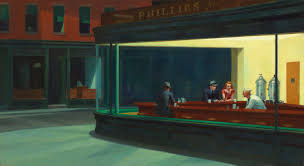
While visiting the Boston Museum of Fine Arts I came upon something that really surprised me. I acquired an appreciation for Edward Hopper (1882-1967). There was an exhibit of his work on tour and I decided to attend. Now we all know Nighthawks. (Part of the permanent collection in the Art Institute of Chicago.)


What I didn’t know was that the rest of his work would blow me away. His use of sunlight and shadow and windows let you see things you’d never think to look at. The museum’s brochure called his work “the ordinary, made extraordinary.” Indeed, he painted very ordinary subjects such as a girl at a sewing machine, a movie theater, people eating at a Chinese restaurant (Chop Suey), and an empty room with sunlight streaming into it. Outdoors he depicted street scenes, lighthouses, a gas station, and tugboats. I became an instant fan.


His influence on other artists was far reaching. His painting House by the Railroad inspired Alfred Hitchcock (the house in Psycho) and Terrence Malick (the house in Days of Heaven).


Many poets wrote poems inspired by his paintings (including your humble servant) and there were collections of these poems gathered along with the pictures. Several documentaries have been made and shown in theaters, museums, and on television about his life and work.

Here are a few of my favorites, but if you ever get the chance to view his paintings in person, do it.

Cape Cod Evening


Compartment C Car


Office in a Small City


Sun in an Empty Room


February 03, 2021

Shakespeare's Sonnets: 1

One of the most controversial writers of all time is William Shakespeare. Did he write those plays or was it someone else? Who were those Sonnets about? Why don’t we know more about his background? Was he Catholic or Protestant? Scholars have been fighting for a few centuries over these and myriad other questions about the Bard of Avon.

Certainly the plays and sonnets were written by the same person, owing to lines and phrases showing up in both places. Although some people still argue against him, Shakespeare is considered by most scholars to have written all this beautiful poetry.

And so today we begin a survey of the 154 Sonnets. They could have been written in the last decade of the 16th century, or they could have been written all through Shakespeare’s career. Nevertheless, they were gathered and published in 1609, with or without the author’s permission. We’ll look at them one at a time. Don’t look for analysis on the meaning; greater minds than your humble servant can’t agree on what they mean. Just enjoy the poetry and ponder the mysteries of the depth of the human person.

Sonnet I

From fairest creatures we desire increase,
That thereby beauty’s rose might never die,
But as the riper should by time decease,
His tender heir might bear his memory:
But thou, contracted to thine own bright eyes,
Feed’st thy light’s flame with self-substantial fuel, 
Making a famine where abundance lies,
Thyself thy foe, to thy sweet self too cruel.
Thou that art now the world’s fresh ornament
And only herald to the gaudy spring,
Within thine own bud buriest thy content
And, tender churl, makest waste in niggarding.
Pity the world, or else this glutton be,
To eat the world’s due, by the grave and thee.

Just one note in case there is any misunderstanding: “niggarding” means being miserly.

February 01, 2021

Proverbs

Webster’s dictionary defines a proverb as a brief epigram or maxim. In the Ignatius Bible RSVCE a proverb is described as “a typical form of expression in a society that depended to a large extent on oral tradition. Each saying expressed in pithy and memorable form some important truth.” Many of these proverbs were attributed to Solomon, but all of the book was divinely inspired.

The Proverbs starts thus (1: 2-7):

That men may know wisdom and instruction, understand words of insight, receive instruction in wise dealing, righteousness, justice, and equity; that prudence may be given to the simple, knowledge and discretion to the youth – the wise man also may hear and increase in learning, and the man of understanding acquire skill, to understand a proverb and a figure, the words of the wise and their riddles.

The fear of the Lord is the beginning of knowledge; fools despise wisdom and instruction.

The Ignatius Bible goes on to say, “The general subject of the proverbs is the art of right living… They are not simply maxims of natural wisdom but presuppose a background of revealed religion and inculcate its principles. Religion is in fact regarded as the basis of all morality.”

The Proverbs certainly deserves to be read in its entirety, but it’s also profitable to open it anywhere and read a few verses from any chapter. Be a friend to Wisdom and not to Folly.

Goodbye...for now

I began this blog on November 16, 2020, and now comes the time to bring it to an end. Or at least put it on hiatus. November 16, 2021, is th...