March 15, 2021

Laetare Sunday

Yesterday was the fourth Sunday of Lent, or Laetare Sunday. Laetare is Latin for rejoice and the Introit (beginning) of the Mass says, “Rejoice O Jerusalem; and gather round, all you who love her.” Since we are deep into Lent, a time of repentance and sorrow, this Sunday is where the faithful catch their breath and ponder the good in this life before continuing their journey on towards the Passion before reaching the beauty and joy of Easter.

The Gospel for this fourth Sunday is taken from John 6:1-15, the telling of the miracle of the five loaves and two fish. I repeat, miracle, because this is not just about sharing and being kind to our neighbor. It is a supernatural occurrence prefiguring Jesus instituting the Eucharist at the Last Supper.

Jesus, knowing exactly what he will do, asks the disciples, “Whence shall we buy bread, that these may eat?” (There were about 5,000 of just men, not to mention women and children.) Verse 7 says, “Phillip answered him: Two hundred pennyworth of bread is not sufficient for them, that every one may take a little.” Andrew adds in Verse 9, “There is a boy here that hath five barley loaves and two fishes. But what are these among so many?”

Some would say that the Apostles were doubtful and worried that nothing could be done, that they were only seeing things from a material point of view. I have a feeling that they were merely pointing out to Jesus the situation and were only waiting instructions from Him, knowing that He would come up with something. After all, they had enough faith to give up everything and follow Him. We then see Jesus give thanks for the bread and fish and distribute them, as He does with the bread and wine at the Last Supper, and as the priest does at each Mass. 

This Gospel reading therefore gives us hope and nourishment to make it the rest of the way. We too will be fed by the words and actions of our Lord Jesus Christ.

March 12, 2021

Shakespeare's Sonnets: IV

Much like Sonnet III, Sonnet IV exhorts the young man to marry and have children, and not waste his time in frivolous pleasures. He has been given a gift, whether of beauty or talent or intelligence, (Shakespeare speaks mostly of beauty, but it could stand for any gift) and owes it to future generations to pass it on. If he doesn’t use this gift wisely, it will die with him. He uses the comparison to a money lender who is miserly (“beauteous niggard”).


Sonnet IV

Unthrifty loveliness, why dost thou spend

Upon thyself thy beauty’s legacy?

Nature’s bequest gives nothing, but doth lend,

And being frank, she lends to those are free.

Then, beauteous niggard, why dost thou abuse

The bounteous largess given thee to give?

Profitless usurer, why dost thou use

So great a sum of sums, yet canst not live?

For having traffic with thyself alone,

Thou of thyself thy sweet self dost deceive.

Then how, when nature calls thee to be gone,

What acceptable audit canst thou leave?

                Thy unused beauty must be tomb’d with thee,

                Which, used, lives th’ executor to be.


March 10, 2021

Wisdom and Truth

These are troubled times. But then, we have had troubled times since Adam and Eve disobeyed God in the Garden of Eden. One of their sons murdered the other. God caused the earth to be covered with water because of the wickedness of His people. Sodom and Gomorrah were completely destroyed because of their depravity. The chosen people were enslaved in Egypt and it took plagues of locusts, frogs, and other afflictions before they escaped. A quick perusal of the Old Testament tells of numerous wars, of peoples being conquered, and many bad leaders who did not follow God’s commandments and led others into sin. People suffered and they died. Now we have instantaneous communication, but that doesn’t lessen the suffering that our predecessors endured nor increase what we are going through. History isn’t an appreciated subject today, but we must learn it to keep our own experience in perspective.

However, we are convinced that no one has had it as hard as we have. We’re stressed and we’re afraid. We see no way out. The Wisdom of Solomon (17:11-13) says, “For wickedness is a cowardly thing, condemned by its own testimony; distressed by conscience, it has always exaggerated the difficulties. For fear is nothing but surrender of the helps that come from reason; and the inner expectation of help, being weak, prefers ignorance of what causes the torment.” Whew! Harsh words, but true. And wisdom and truth go hand in hand. The more we turn from God and rely on our own devices, the further away wisdom and truth become.

The book of Sirach tells us that “Wisdom exalts her sons and gives help to those who seek her.” (4:11) It goes on to say (4:20-28): “Observe the right time, and beware of evil; and do not bring shame on yourself. For there is a shame which brings sin, and there is a shame which is glory and favor. Do not show partiality, to your own harm, or deference to your downfall. Do not refrain from speaking at the crucial time, and do not hide your wisdom. For wisdom is known through speech, and education through the words of the tongue. Never speak against the truth, but be mindful of your ignorance. Do not be ashamed to confess your sins, and do not try to stop the current of a river. Do not subject yourself to a foolish fellow, nor show partiality to a ruler. Strive even to death for the truth and the Lord God will fight for you.”

Strive even to death for the truth and the Lord God will fight for you.

God is truth, and if we have God, we have everything we need. Jesus tells us over and over, “Be not afraid.” Let us tell Him, “Jesus, I trust in you.”

March 08, 2021

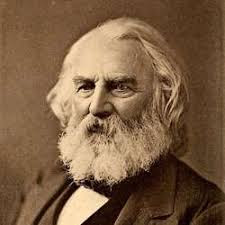
Henry Wadsworth Longfellow

Tucked away from the hustle and bustle of Congress Street, the main drag in downtown Portland, Maine, is the boyhood home of Henry Wadsworth Longfellow (February 27, 1807 – March 24, 1882). Despite what Wikipedia says, the house was not demolished in 1955, and in fact, we spent many lunchtimes sitting in the garden in the back of the house enjoying the quiet and peace. A statue of the beloved poet sits in the middle of Congress Square, several blocks away from his birthplace.

Portland is deservedly proud of this poet of such works as “Paul Revere’s Ride,” “The Courtship of Miles Standish,” “The Song of Hiawatha,” “Evangeline,” and “The Village Blacksmith.” Minneapolis also recognizes Longfellow because of the popularity of “The Song of Hiawatha” and Minnehaha Falls, and named a neighborhood after him.

You may have heard many famous lines and never knew you were hearing Longfellow’s poetry. Perhaps the most famous is the song “I Heard the Bells on Christmas Day.” Others are:

I shot an arrow in the air, It fell to earth, I know not where.

Though the mills of God grind slowly, they grind exceeding small.

Listen, my children, and you shall hear of the midnight ride of Paul Revere.

Under a spreading chestnut tree, the village smithy stands.

Oh ye dead Poets, who are living still.

Into each life some rain must fall.

This last quote is from “The Rainy Day” which will be our selection for today. Enjoy!


The day is cold, and dark, and dreary;

It rains, and the wind is never weary;

The vine still clings to the mouldering wall,

But at every gust the dead leaves fall,

                And the day is dark and dreary.


My life is cold, and dark, and dreary;

It rains, and the wind is never weary;

My thoughts still cling to the mouldering Past,

But the hopes of youth fall thick in the blast,

                And the days are dark and dreary.


Be still, sad heart! and cease repining;

Behind the clouds is the sun still shining;

Thy fate is the common fate of all,

Into each life some rain must fall,

                Some days must be dark and dreary.


March 05, 2021

Happy Birthday Handel

Georg Friederich Handel, the composer of my favorite piece of classical music Messiah, was born on March 5, 1685 in Prussia. Having moved to Britain in 1712, he became a British citizen in 1727 and is considered a British composer. Most of his great works such as Messiah, Music for the Royal Fireworks, and Water Music were composed while he lived in England.

He also wrote scores of operas, oratorios, and concerti grossi. In 1727 he was commissioned to write four anthems for the coronation of George II. One of these anthems has been played at each coronation since. The words to Zadok the Priest come from the King James Bible, 1st Kings where David instructs Zadok the Priest and Nathan the Prophet to anoint Solomon King over Israel. Here are the words as used in the anthem:

Zadok the Priest, and Nathan the Prophet anointed Solomon King. And all the people rejoiced, and said: God save the King! Long live the King! May the King live for ever, Amen, Alleluia.

This being baroque music, there are of course, many repeated phrases. 

Here is a video of the Westminster Abbey Choir and Choristers of the Chapel Royal performing the piece with organ accompaniment. The striking thing is that this is how this sounded in Handel’s time. And if it isn’t, he’d probably come up through the floor, for this is where Handel is buried, having died in April 1759.

Oh, by the way, soccer fans know this better as the Champions League Anthem. (Different words, of course.)


March 03, 2021

Works of Mercy

During Lent it’s important to take the time to find ways to make our actions follow our thoughts and words of love for our Lord. Luke 10:27 tells us “Thou shalt love the Lord thy God with thy whole heart, and with thy whole soul, and with all thy strength, and with all thy mind: and thy neighbor as thyself.” So how do we do this?


The Church teaches us the Corporal Works of Mercy and the Spiritual Works of Mercy. These are:


The Corporal (Material) Works of Mercy

1. To feed the hungry.

2. To give drink to the thirsty.

3. To clothe the naked.

4. To visit the imprisoned.

5. To shelter the homeless.

6. To visit the sick.

7. To bury the dead.


The Spiritual Works of Mercy

1. To admonish the sinner. 

2. To instruct the ignorant.

3. To counsel the doubtful.

4. To comfort the sorrowful.

5. To bear wrongs patiently.

6. To forgive all injuries.

7. To pray for the living and the dead.

So, if you can’t go down to the homeless shelter and ladle soup, can you support them financially? Or the pro-life groups if you can’t pray in front of the abortion mills? Can you be a sympathetic listener to someone who is going through a tough time? Can you smile and say hello to a stranger (even if you’re wearing a mask) who might need a kind word? Can you donate clothing you don't wear to a thrift shop?


How about bearing wrongs patiently or forgiving someone who has done something against you? Yes, those take a lot of practice, but if we expect God to do this for us, we need to make the effort to do this for others. (Forgive us our trespasses as we forgive those who trespass against us.)


Lent is a good place to start on practicing these things, but remember, they don’t end on Easter. If we want to show God how much we love Him, it’s a year-round thing.


Pray, pray, pray.

March 01, 2021

Happy Birthday Rossini

Happy Birthday to Gioachino Rossini (February 29, 1792 – November 13, 1868)

Rossini wrote 39 operas as well as songs, chamber music, and sacred music, borrowing from himself quite often (not an unusual occurrence among composers). He retired from opera composing at the age of 37 due to poor health and moved back and forth between cities in Italy and Paris, dying in Paris at age 76. 

Rossini was a master of the overture, even if they were formulaic in nature. His last opera, Guillaume Tell (William Tell), produced an overture that is immediately recognizable today, even if you’ve never heard an opera in your life – the theme to the Lone Ranger.

Although you might be even more familiar with the overture to Il barbiere di Siviglia (the Barber of Seville). Remember Bugs Bunny as the barber and Elmer Fudd as the customer? (“Yes, you’re next. You’re so next.”) Click on this link to Daily Motion and view the cartoon. For those who’d like to hear the real thing, click on the video below. When we first saw the Barber at the Minnesota Opera, I looked around at the crowd during the overture and more than one person displayed a huge grin, leading me to believe that once you’ve seen the cartoon, it’s impossible not to think of it when you hear the piece.

The burning question I still have about Rossini is, did he celebrate his birthday on February 28 or March 1? Happy birthday either way.


Goodbye...for now

I began this blog on November 16, 2020, and now comes the time to bring it to an end. Or at least put it on hiatus. November 16, 2021, is th...